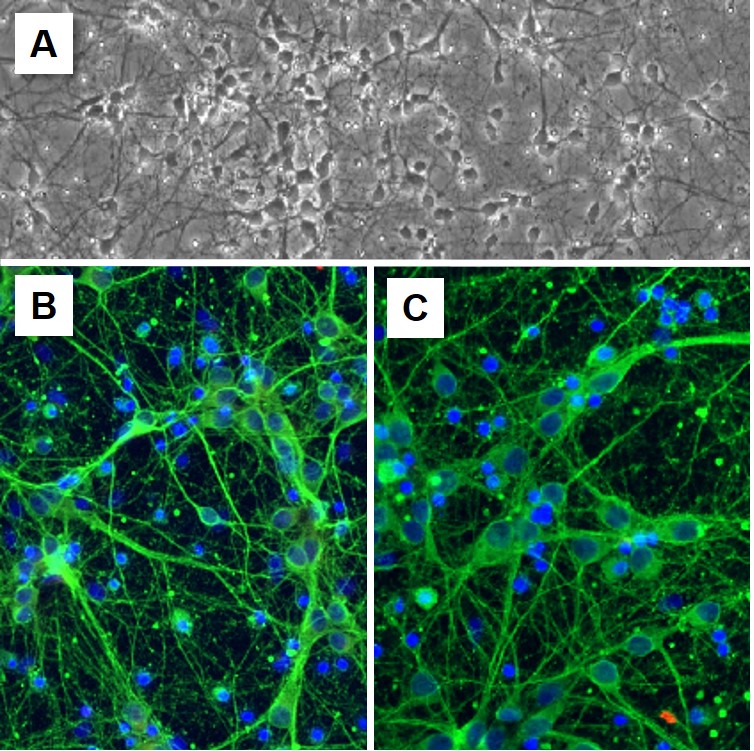
Freshly isolated Rat Cortical Neurons (RCoN) cultured for 5 days (A). Freshly isolated RCoN (B), and revived cryopreserved RCoN (C) stained on day 8 for β III-Tubulin (green), GFAP (red), and DAPI (blue).
Rat Cortical Neurons: RCoN
Rat cortical neurons (RCoN) are primary rat cortical neurons isolated from the cerebral cortices of rats.
Description
Rat cortical neurons (RCoN) are primary rat cortical neurons typically isolated from the cerebral cortices of embryonic day 17–18 (E17–E18) Sprague-Dawley rats. When thawed from cryopreserved neurons, handled as a delicate cell suspension, and plated onto a proper substrate such as a poly-D-lysine matrix, these primary rat neurons rapidly recover. Over the course of approximately one week in a specialized neuronal culture, each nerve cell undergoes extensive morphological maturation, extending a complex network of arborized axons and dendrites from its central cell body.
In vitro, these primary rodent neurons serve as a highly authentic cell type model for neurobiology. Unlike a continuous cell line, such as PC12 cells or other immortalized neuroblastoma alternatives that exhibit shifted phenotypes and continuous division, RCoN stop dividing and focus energy on network formation. Because post-mitotic primary cells are sensitive, maintaining viability during isolation is critical. Quality control includes assessing the neuronal marker β-III-tubulin (TUBB3) and meticulous screening to ensure they are free of mycoplasma. Thorough neural characterization via precise cell counting protocols helps investigators verify starting viability before establishing long-term functional networks.
In the living animal, these cells are native to the cerebral cortex — the outer layer of neural tissue covering the brain’s cerebral hemispheres. They represent a distinctly different anatomical population compared to other widely studied primary cells, such as hippocampal neurons (which are associated with the hippocampus in the medial temporal lobe), or peripheral nervous system models like dorsal root ganglion cells (pseudounipolar cells found in the dorsal root ganglia, located just outside the spinal cord).
The cerebral cortex is highly organized into distinct layers and functional columns. Within this dense tissue architecture, rat cortical neurons integrate a vast array of synaptic inputs from across the central nervous system, establishing the structural basis for complex neurocircuitry.
The primary function of a rat cortical neuron is to process, integrate, and transmit electrical and chemical signals that drive higher-order neurological function. The cerebral cortex itself plays a foundational role in cognition, memory, voluntary movement, sensory perception, and attention.
To accomplish this, each individual cell depends on robust cell signaling machinery and tightly regulated signaling pathways. When an action potential reaches a nerve terminal, it triggers the release of specific chemical messengers into the synaptic cleft. Studying this neurotransmitter function is essential to understanding how networks pass information, mediate synaptic transmission, and modulate synaptic strength. A finely tuned network of these cells is necessary for maintaining cognitive functions, coordinating sensory-motor feedback, and ensuring proper regulatory control over the rest of the body.
In modern neurobiology and neuropharmacology, RCoN represent a useful model system to study disease mechanisms, analyze pathobiological pathways, and evaluate advanced cell culture models. Because cellular degeneration or synaptic dysfunction in the cortex underlies many brain injuries, stroke pathways, and psychiatric or neurological disorders, rat cortical neurons are used extensively to monitor structural degradation. Investigators often use high-content imaging systems to track neurite outgrowth kinetics or measure cell viability when exposed to toxic stimuli, such as toxic protein aggregates or excitotoxic levels of glutamate.
To maintain these sensitive cells in long-term functional experiments, researchers depend on optimized formulations such as the Rat Neuron Culture Medium Kit with with targeted supplements, or specialized Rat Neuron Culture Medium. These controlled platforms allow for a wide range of analytical methodologies, including patch-clamp electrophysiology, transfection or viral transduction methods, and multi-electrode array (MEA) recording to track functional network activity over time. Furthermore, primary rodent neurons provide a valuable translational benchmark alongside emerging human models — such as human iPSC-derived neurons — helping researchers identify conserved evolutionary mechanisms and screen candidate small molecules during early-stage drug development and neurotoxicity testing.
Rat cortical neurons (RCoN) are derived from cerebral cortices of day 18 embryonic Sprague Dawley rat brains. When cultured under the recommended conditions, RCoN arborize and form complex neurite network in one week. RCoN Stain positive for β III-Tubulin.
The cerebral cortex plays a key role in cognition, memory, attention, perceptual awareness, thought, language and consciousness. Neurons connect to other neural cells through neurites and synapses to form complex neurocircuitry for signal transmission. A healthy circuitry in the brain is essential for cognitive functions, proper control and regulation of the other parts of the body. Dysfunction and degeneration in the cerebral cortex have been implicated in various brain injuries, neurological and psychiatric disorders. Cortical neurons, therefore, provide an excellent cellular model system to study disease mechanisms and pathophysiologies. They also serve as a platform for drug screening and development, toxicity tests, immunostaining, live cell imaging, co-culturing and electrophysiology.
Details
| Tissue | Normal healthy rat brain cortex | |
|---|---|---|
| QC | No bacteria, yeast, fungi, mycoplasma | |
| Character | Positive for β-III Tubulin | |
| Bioassay | Plate on Poly-D-Lysine coated surface, arborize to form neurite network in Culture Med | |
| Cryovial | 2M RCoN cryopreserved after isolation in Serum-Free Freezing Medium (042-50) | |
| Kit (2M) | 2M cryopreserved RCoN (R882N-20), Coating Soln I (027-05), Plating Med (R817P-10), Culture Med (R817-100) | |
| Doublings | N/A – Neurons don’t proliferate in vitro | |
| Applications | Laboratory research use only (RUO). Not for human, clinical, diagnostic or veterinary use. |
Resources
FAQs
Need More Help?
Visit our comprehensive FAQ page for detailed answers to common questions.
Need More Help?
Visit our comprehensive FAQ page for detailed answers to common questions.
Primary Cell FAQs